Friday, July 29, 2011

Epilogue

The crew of the Endurance
This section is all about the rescues. The three men on the other side of South Georgia are rescued first. This is able to be done rather easily. Then it comes time to rescue those on Elephant Island. Shackleton gives many attempts to rescue them, all failing. Then, when he tries once more, he is able to make it to the island. The men on Elephant Island were just living life as usual when they saw the ship, and tried to give signal to said ship. Shackleton rescues them, and they are all survive. Lansing writes, "It had been four months and six days since the Caird had left, and there was not a man among them who still believed seriously that she had survived the journey to South Georgia." This shows that when the men had lost all hope, they were saved. This conclusion represents an archetype in fiction portrayed in real life. That is everyone living happily ever after. None of the crew has died, and the worst off are simply missing their feet. For the long journey they've been on, that is a great outcome.

Part VII

Jack Bauer
Shackleton and his crew reach South Georgia, but are on the wrong side of the island. Lansing, the narrator,  writes, "Yet even in that small moment of victory, tragedy threatened. The surf inside the cove was especially heavy. It had swung the Caird's stern around, and she was pounding against the rocks." This shows that whenever life seems to be getting better for the crew, it somehow always finds a way to become worse. He realizes that he must get to the bay where the whalers are located. He and his crew take a few days rest, then decide to sail about six miles to another bay. From there, Shackleton and two other men go on a mad dash to the whaling bay via land. No one else had ever attempted to cross the island in this fashion. They reach the whaling bay after more of the trials and tribulations that Ernest faced throughout his entire journey. He finds the man Storle, who cannot believe his eyes. Shackleton's tenacity, and ability to take everything thrown at him head on reminded me of Jack Bauer on the show 24. They both face seemingly impossible challenges, yet somehow find a way to overcome them.

Part VI

A picture of the rugged Sir Earnest Shackleton
Part VI is all about the rescue team's journey to South Georgia. Their journey is very challenging. The men; however, endure the hardships in order to reach the land. They hurdle many adversities to reach South Georgia. The men are constantly getting battered by the sea, that is freezing onto them, making every movement torturous. Then as if the odyssey isn't difficult enough, they lose their anchor. Then, after they use their first jug of water, they find that the second jug has been contaminated with salt water. Even though the odds are against them, the group lands on South Georgia 522 days after they left it. Lansing chronicles regarding Shackleton, "The truth was that he felt rather out of his element. He had proved himself on land. He had demonstrated there beyond all doubt his ability to pit his matchless tenacity against the elements-and win. But the sea is a different ssort of enemy. Unlike the land where courage and the simple will to endure can often see a man through, the struggle against the sea is an act of physical combat, and there is no escape. It is a battle against a tireless enemy in which man never actually wins; the most that he can hope for is not to be defeated." This shows that Shackleton is a round character, with deep complexities.

Part V Chapters 4-6

A composite photograph/drawing of the crew's hut
The men begin to get used to life on the Elephant Island. At first, they attempt to cut into a glacier to make a cave for shelter. The cave ends up being dug, but they find that the sides melt from the men's body heat. They then turn to find a new shelter. They pile up rocks, and put the boats overhead to create shelters. Neither they or we know not what has happened to Shackleton and his rescue team. The men live, in relative comfort,  for months, not knowing whether or not Shackleton has reached South Georgia. In the meanwhile, they live life as usual for most of the time. They do decide; however, that Blackboro's foot, infected with gangreen must be amputated. They are able to do this quickly, and as cleanly as they can. The men are then treated to a special celebration on MidWinter's day. They eat well, and are thoroughly entertained by the acts certain members of the crew puts on. James puts on a near limerick singing "My name is Frankie-O; my hut's on Elephant Isle. The wall's without a single brick, the roof's without a tile. ut nevertheless, you must confess, for many and many a mile, It's the most palatial dwelling place you'll find on Elephant Isle. After their celebration, morale comes to an all time low. The men begin to think that Shackleton will never come back, leaving them stuck on Elephant Isle.

Part V Chapters 1-3


A Group of Seals
The crew has finally reached land. Their death defying voyage to Elephant Island is over, and the men can have what they crave most, sleep. James writes "Turned in and slept, as we had never slept before, absolute dead dreamless sleep, oblivious of wet sleeping bags, lulled by croaking penguins." This shows just how integral sleep is to the human life. The men had been rowing for days straight without a chance of sleep. The men can finally become comfortable as they are able to procure four seals, and need not worry about food. Then, Shackleton tells the men that they must leave and go to another beach about seven miles away, for, if the storms get worse, they could become lost underwater. Just as they begin to get comfortable, the men once again have to sail in the freezing antarctic conditions exposed to the elements, and likely to get even more frostbitten. When the men reach their new island they capture seventy-seven penguins. Then, Shackleton gives news that he and a party of five men would attempt to reach South Georgia Island. Before they leave, Shackleton gives responsibility, of the crew, should he not return to Frank Wild. Then, Shackleton sets out to reach South Georgia. In this, Shackleton leaves an implication that he may not returnl

Part IV
A map of Elephant Island
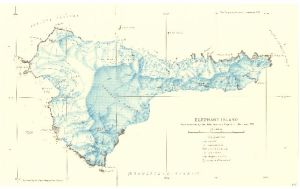
This section of the book chronicles the crew's journey by sea. They go out on the three boats, into the frozen antarctic waters. Their journey is perilous, the crew is battered by the water, and frozen in place. They begin to get frostbitten, with Greenstreet's feet becoming almost entirely frostbitten. The ships soon decide to split up, with the Docker going out on it's own, while the Caird and the Willis went tethered together. The men row to exhaustion trying to get to Elephant Island. The men become dehydrated, and seasick, making an already difficult journey all the worse. Their exhaustion finally pays off however when they reach Elephant Island. Lancing writes, "For the first time in 497 days they were on land. Solid, unsinkable immovable blessed land. This seems to be the turning point in the story, for all the rest of it, they were either in the endurance, stuck on a floe, or in their life ships struggling to get to land.

Part III Chapters 4-6

A life boat of the Titanic
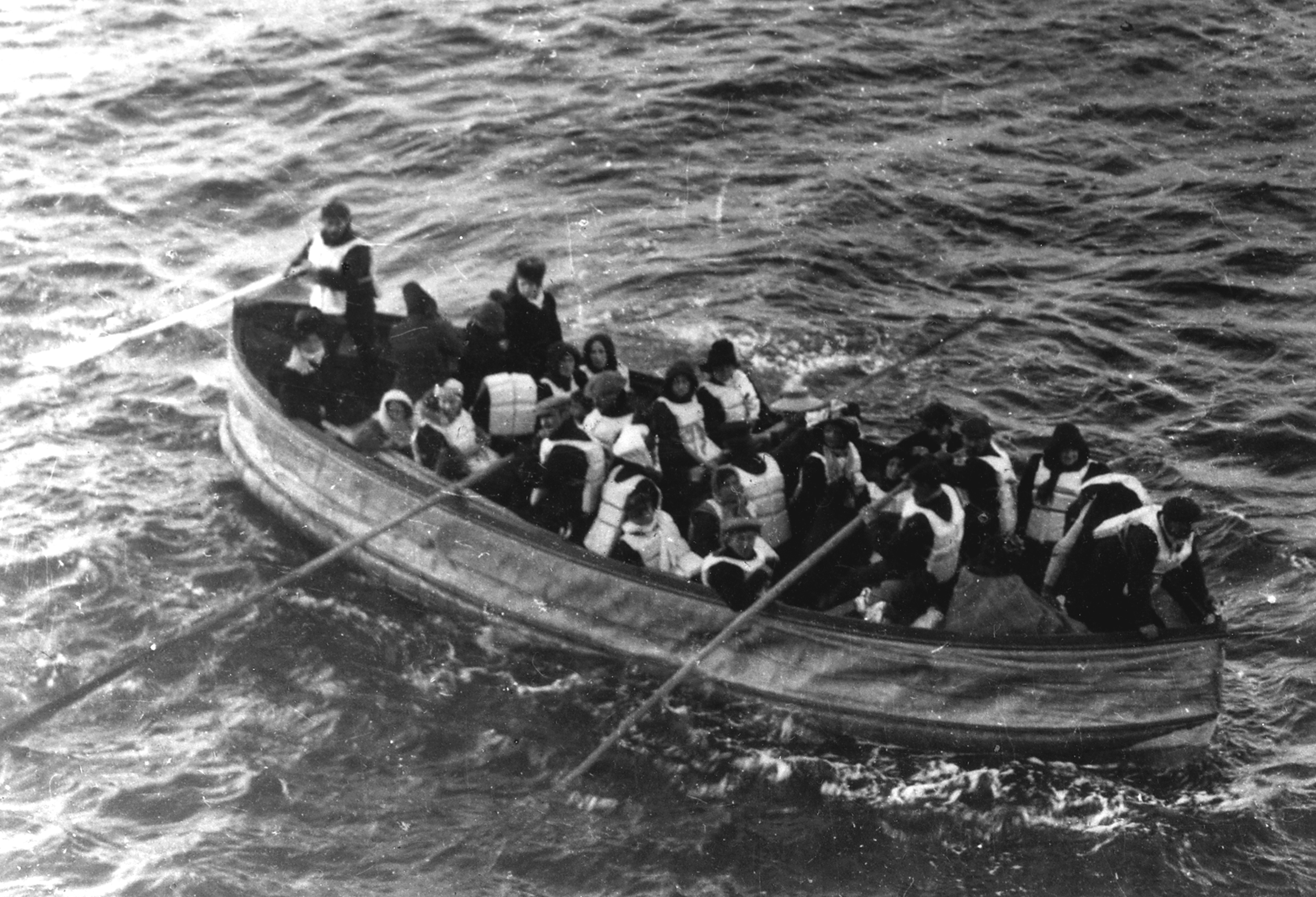
The crew's food supply is beginning to reach an all time low. They are quickly running out of food. Some of the men even joke about cannibalism. When the mens' spirits are at an all time low, they see land. It is one of the tiny danger islets 42 miles away from the men. They know, however; that because of the condition of the ice ahead they will not be able to reach the land. With the lack of food, and the inability to go to land, the men have little motivation to do anything, but Just when it seems the crew is going to run out of food, they sight two seals, killing one. Then, the floe splits. The men are able to work through it and another split without to much trouble. Then, Wild sees a sea leopard, and is able to kill it for nearly 1,000 pounds of food. Lansing writes, "With one bullet it, seemed, Wild had changed the whole complexion of their lives." The dogs as well are shot for food. The swell then breaks up even more, forcing the crew to decide whether or not to ship off in their boats. The going out on lifeboats, made me think of the titanic. The people that would survive the wreck would have to get into a life boat first, and as that represented life for the people who were on the titanic, it also represents life for the crew of the endurance because it can bring them to land.
.

Part III Chapters 1-3

In Part III, the men have become stuck on a new flow, that they call Mark Time Camp. The men's cheerfulness is now beginning to fade. The crew has over 200 miles to march to get to land, but in five days, they have gone only nine miles and are now stuck. The men wish only for a break from the ennui of life on ice. Then, Thomas Orde-Lees gets attacked by a seal. It chases him, and nearly catches him when Wild shoots it dead. The seal weighed in at over 1,000 pounds. While the rest of the crew believes that as much meat as possible should be brought in. Shackleton; however, disagrees. Lancing writes "This indomitable self-confidence of Shackleton's took the form of optimism . And it worked in two ways: it set men's souls on fire; as Macklin said, just to be in his presence was an experience." This optimism; however, nearly becomes the crew's downfall. They begin to run out of meat. Because the camp does not have nearly enough meat, Shackleton quietly has three of the dog teams killed. This brings the crew's moral greatly down. When there seemed to be nothing but good news, the wind begins to kick up to the north. The men are then in good spirits thinking they may just reach Paulet Island. However, as time progresses, they go too far north, with too little western movement. At this point in the story, it seems as if it may become a tragedy. There is little good news to be had for the crew of the endurance at this point.

Thursday, July 28, 2011

Part II Chapter 4-6

The world's largest Buddha statue
Over the course of time the crew has been on the floe, they become acclimated with life on the ice. The men are now able to live comfortably enough, and have little worries. Over time; however, the men become bored with the monotony of living on the ice. The men are isolated on their island of ice. Lansing writes "In some ways they had come to know themselves better. In this lonely world of ice and emptiness, they had achieved at least a limited kind of contentment. They had been tested and found not wanting. This made me think of the novel Siddhartha by Herman Hesse. Hesse's story is of the future buddha's quest for absolute enlightenment, that is his way of being one with the universe. At one point in Siddhartha's quest, he joins a group that's path to enlightenment is that of not wanting. This is similar to the crew of the Endurance except that what Siddhartha did on his own, the crew is being forced to do. The crew later then, decides to head West, no matter what the cost. Just before Christmas, the men feast, knowing that they will have to abandon their so called "Ocean Camp." The crew sets off and works through Christmas all the way to New Years.

Part II Chapter 1-3

Hurley kills a seal with a club, just as I imagine a caveman would have.
As part I came to an end, the crew of the Endurance were told to abandon ship. Previously, the primary setting of the story was inside the ship. Now it has moved onto a floe a couple miles away from the ship. The crew, originally plans on walking near three hundred and fifty miles, but get stuck about a mile away from the boat. The men, stuck out in the middle of the antarctic, are in surprisingly good spirits. Even when they realize that they are most likely going to stay on the same floe for months, they still aren't down. At the end of the chapter, Shackleton comes up with his plan. It is to stay on the floe that is headed to the northwest to Snow Hill Island. Once they reach would have to travel for another hundred and fifty miles to get to Wilhelmina Bay, a whaling station that could get them rescued. The ship's captain, Frank Worsley, wrote "The rapidity with which one can completely change one's ideas... and accomodate ourselves to a state of barbarism is wonderful." This is seen especially when Lansing writes "As they trudged along beside the sledges, Hurley spotted a large Weddell seal about a thousands yards off to the right. He had no gun with which to kill it so he took a piece of wood and approached the seal cautiously. When he was close enough, he stunned the animal with his club. Then he brained it with a mountaineer's pickaxe." I found it interesting that a man can go from the ship's photographer to a primitive hunter.

Tuesday, July 26, 2011

Part I Chapters 5-8

In the latter half of part I, Lansing gives a more in depth profile of each man on the endurance. The reader begins to know each man personally, from the great captain Shackleton to the cook, Charlie Green. The men seem to adjust to their position relatively easily. None seem distraught that they are stuck in the ice. Then, the so call Antarctic night sets in, bringing the beginning of the winter, and the end of the sunlight. The men, instead of becoming distraught at their predicament, become a close group. They collectively shave their heads, and begin weekly and monthly rituals to bring a sense of normalcy to their lives. Every Saturday they drink, and every Sunday they listen to music. Once a month, the photographer gives lectures on the majestic locations he has traversed to. The men even have dog races, and seem to truly be having a good time while they are cemented in between floes of ice. On midwinter's day, the men put on a comedy show of sorts, and their morale seems to be especially high. On the heels of the show, a great storm comes in, forcing the men to stay below deck, and shifting the ice. Reflecting on this, Worsley says "Many of the tabular bergs appear like huge warehouses and grain elevators, but more look like the creations of some brilliant architect when suffering from delirium, induced by gazing too long on the damned internal stationary pack that seems ...doomed to drift to and fro till the Crack of Doom splits and shivers it N., S., E. & W. into a thousand million fragments-and the smaller the better. No animal life observed-no land-no nothing!!!" This is an elaborate example of figurative language. The floes then begin to close in on the ship. The ship is attacked multiple times, but each time it resists. At one point the ship is lifted by the ice and slanted upward, sliding the equipment on deck. The boat that rights itself. Later, the ice begins to close in around the boat, bending the hull. Then, the boat gets a leak. The men work tirelessly to mend the leak, and get the water out, but it is to no avail. They are forced to abandon ship.

Endurance Part 1 Chapter 1-4

Endurance, as the sub title will tell you is of Ernest Shackleton's great journey, his quest to be the first to cross the antarctic. Lansing begins the story in peculiar fashion.  This story, rather than beginning with the background information behind the voyage, begins with Shackleton's order to abandon ship. The ship has been stuck in the ice for quite some time, and is beginning to be crushed by the immense pressure of the ice surrounding it. This brings with it a quite dreary mood. This is exemplified when Lansing writes: "Ordinarily, any activity of this sort would have driven the dogs mad with excitement, bu somehow they seemed to sense that something very extraordinary was going on. Not one fight broke out among them, and not a single dog attempted to break away." This shows that the atmosphere surrounding the floundering ship is one of seriousness. I found it interesting that amongst all the commotion, the dogs are able to sense the dire situation. Lansing then leaves the ship wreck to tell about Shackleton's intense preparations for the journey. Shackleton and his crew then begin their journey with only minor set backs until they reach a large section of ice. While they are attempting to get through it, they are hit by a strong northernly wind that freezes the ice in place, locking Endurance in the ice without a chance of escape.